
How to Set Up a Business in Panama: Legal Guide 2026
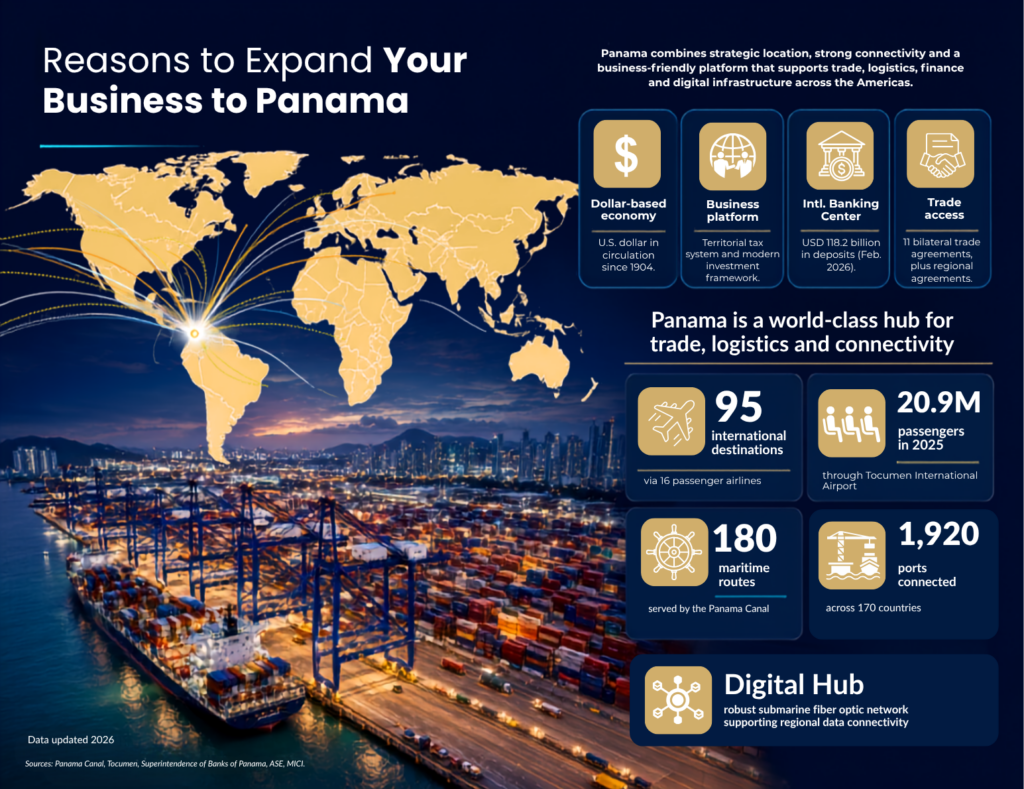
Panama has built its reputation as a business hub over more than a century, anchored in the Panama Canal, a fully dollarized economy, and a territorial tax system. For foreign investors and executives evaluating market entry, the opportunity is real, but it depends on getting four things right from the start: the corporate structure, the permits, the tax and compliance obligations, and the immigration process for staff on the ground.
Our attorneys have prepared a complete legal guide, “How to Expand Your Business to Panama: Company Registration, Tax, Immigration and AML Compliance”, to walk investors through every one of those steps in detail, along with a full FAQ section and direct contacts on our team. This article covers the framework; you can download the complete guide at the end.
Choosing the Right Corporate Structure
Most foreign investors incorporate as a Sociedad Anónima (S.A.), Panama’s equivalent of a corporation, governed by Law 32 of 1927. It requires three directors (who may be corporate entities), has no minimum capital requirement in practice, and allows directors and officers of any nationality without a residency requirement. A licensed Panamanian attorney must act as resident agent, a legal requirement for every incorporation.
Two other structures exist depending on your situation: the Sociedad de Responsabilidad Limitada (S. de R.L.), often used by U.S. tax residents who want pass-through treatment, and the branch of a foreign corporation, common in banking, insurance, and construction, where the parent company retains full liability.
How Company Registration Works
Incorporating a Sociedad Anónima follows a defined sequence: drafting and executing the Articles of Incorporation before a Panamanian notary, filing with the Public Registry (3 to 5 business days), obtaining a Tax Identification Number (RUC) from the Dirección General de Ingresos, securing the corresponding commercial license from the Ministry of Commerce and Industry, and registering with the Social Security Office (CSS) before hiring any staff.
Incorporation itself is fast. Full operational readiness, meaning every permit, registration, and a working bank account, typically takes between 30 and 60 days depending on the industry.
Permits and Licenses by Industry
Every business needs a baseline Aviso de Operación from the Ministry of Commerce and Industry, renewed annually. Beyond that, many sectors require additional authorization: banking and financial services through the Superintendencia de Bancos, insurance through the SSRP, securities through the SMV, digital asset services through the SSNF or SBP, healthcare through MINSA, and construction through the Ministry of Public Works and municipal authorities. Businesses operating from a physical location also need municipal permits covering fire safety, health, and zoning compliance.
Immigration for Foreign Executives and Staff
If you or your team will work in Panama, immigration status has to be resolved before operations begin. Panama offers work permit categories for corporate executives and personnel in positions of trust, along with special categories for companies operating in Panama Pacifico, the Colon Free Zone, and other economic regimes. Panama’s Labor Code caps foreign employees at 10% of the workforce in ordinary positions and 15% for technical or specialized roles.
For residency, the Qualified Investor Visa and the Friendly Nations Visa are the two most commonly used pathways, each with its own minimum investment thresholds and eligibility criteria.
Tax and Compliance Obligations
Panama’s territorial tax system exempts foreign-source income from Panamanian corporate income tax, even when earned by a Panama-incorporated entity. Companies with Panamanian-source income pay a flat 25% corporate income tax, plus 7% ITBMS (Panama’s VAT equivalent) on local sales and services. Every incorporated company, regardless of where its income originates, pays an annual USD 300 franchise tax to the Public Registry.
One update for 2026: Law 526, enacted in May and applicable from fiscal year 2027, introduces economic substance requirements for companies that are part of a multinational group and earn passive foreign-source income such as dividends, interest, or royalties. If that applies to your structure, substance compliance now needs to be part of your planning.
AML/CFT compliance is also non-negotiable. Regulated businesses and professionals, including lawyers, accountants, and real estate brokers, are subject to Know Your Customer obligations, suspicious transaction reporting, and record-keeping duties under Law 23 of 2015.
Special Economic Regimes Worth Evaluating
Depending on your industry, operating under one of Panama’s special regimes can materially change your tax exposure and labor flexibility: Panama Pacifico for logistics, aviation, and technology companies; the Colon Free Zone, the largest free trade zone in the Americas by volume; the Multinational Headquarters Regime (SEM) for companies establishing a regional or global headquarters in Panama; and tourism incentive regimes for hotel and hospitality projects meeting investment thresholds.
Opening a Corporate Bank Account
This is where many foreign businesses hit friction. Panamanian banks apply rigorous KYC and due diligence standards, often more demanding than other jurisdictions, and will typically require certified corporate documents, KYC documentation for all beneficial owners and signatories, a business plan, and banking references. The process can take anywhere from a few weeks to several months, and working with counsel that has established banking relationships materially shortens the timeline.
The Bottom Line
Panama is a genuinely business-friendly jurisdiction, but entry is not automatic. The businesses that move through the process most efficiently engage qualified local counsel early, prepare documentation proactively, and treat compliance as a foundation rather than an obstacle.

Chanis has built this guide, “How to Expand Your Business to Panama”, to give you the complete legal roadmap in one document: full detail on every step above, a frequently asked questions section, and direct contacts on our team for each area of practice.